Probate & Trust Administration
Back
Our probate lawyers can help people organize their affairs and establish an efficient plan for the disposition of their assets. When death occurs, our experienced staff of probate and trust administration specialists stands ready to carry out the deceased person’s wishes, which may have been expressed through a will, a revocable trust, beneficiary designations, or a combination of approaches.
Through active participation in state and national associations, our lawyers and paralegals bring a wide variety of skills to the tasks of settling estates and administering trusts, including in-depth knowledge of the probate process, state and federal tax laws, real estate law, trust law, and estate and trust litigation.
We understand that the attorney-client relationship is seldom as personal as when a family places its faith and trust in our ability to assist them after a loved one has died. Depending on a family’s particular circumstances, our attentive staff of lawyers and paralegals is able to provide a wide range of services, including:
- Identification and valuation of assets.
- Preparation of an inventory of assets and a formal accounting.
- Identification and notification of heirs and creditors.
- Assessment of the validity of claims against the estate or trust.
- Publication of all required notices.
- Management and investment of assets.
- Sale of assets.
- Payment of debts and expenses of administration.
- Payment of valid claims of creditors.
- Filing and payment of federal and state income, estate and gift tax returns.
- Representation of estate or trust in disputes with taxing authorities.
- Distribution of assets to beneficiaries.
- Closure of probate or trust administration.
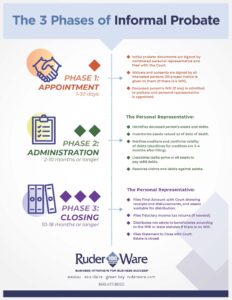
The probate process is complicated, therefore we’ve created an infographic to explain the Three Phases of Informal Probate.
Founded in 1920, Ruder Ware provides business, employment, estate planning, and litigation services. A full-service law firm, over 45 attorneys provide clients with a one-stop approach to their legal needs. Ruder Ware, Business Attorneys for Business Success.
Back
Posted on July 23, 2026 by McKenna K. Coffeen
When applying for Wisconsin Medicaid long-term care programs, financial eligibility is only part of the process. Individuals must also demonstrate that they meet the required level of care through what is known as the functional screen test. The functional screen is a standardized assessment used in Wisconsin to determine whether an individual qualifies for Medicaid-funded […]
Posted on July 8, 2026 by McKenna K. Coffeen
One of the most common concerns families face when discussing long-term care is cost. Whether care is provided at home, in an assisted living facility, or in a nursing home, long-term care expenses can become significant very quickly. In Wisconsin, nursing home care can cost thousands of dollars each month, and even part-time in-home assistance […]
Posted on June 24, 2026 by McKenna K. Coffeen
When a loved one begins to need help with daily activities, families often face difficult decisions about care. Long-term care is not limited to nursing homes—it includes a wide range of services that help individuals manage daily living when age, illness, disability, or cognitive decline makes independent living difficult. Long-term care may include help with […]
Posted on July 10, 2025 by Amy E. Ebeling, Jacob A. Schraeder and Bryce B. Ebben
As you may be aware, on July 4, 2025, a landmark piece of tax legislation – commonly referred to as “One Big Beautiful Bill Act” – was signed into law, ushering in some of the most significant changes to the tax code in recent years. This sweeping bill touches nearly every corner of the tax […]
Posted on January 9, 2024 by Ruth M. Ross
As people begin to think about passing on their assets to the next generation, some consider gifting to their children during their life, rather than passing their assets by inheritance at their death. Possible motivations for this type of transfer include transferring ownership of a business to a child or the protection of assets in […]
Posted on December 28, 2023 by Linda M. Danielson
There is a lot of confusion about estate planning. This is understandable. Most people don’t deal with these issues on a regular basis, and planning for what happens when we die or become incapacitated isn’t something most of us like to think or talk about. Common misconceptions about estate planning include: 1. Having a will […]
Posted on October 23, 2023 by Mykayla A. Dado
When your days are consumed with running a business, it can be hard to look ahead towards tomorrow’s to-do list, much less towards a to-do list for something far in the future, like estate planning. If you’ve pushed off putting in writing what will happen to your business once you’re gone, it’s time to tackle […]
Posted on April 11, 2023 by Shanna N. Fink
Many clients wonder who is responsible for planning their funeral, selecting burial or cremation, and making other arrangements after their death. Some clients ask what happens if family members disagree about these matters. In Wisconsin, there is a default law that dictates who has the authority to make these decisions after your death. The default […]
Posted on December 15, 2022 by Ashley L. Hawley
When I meet with new clients I have them fill out what we refer to as our estate planning “questionnaire.” Basically, a form that asks them to insert personal information on the first two pages and financial information on pages 3-5. Page one asks about marital status and page two asks the potential client to […]
Posted on November 15, 2022 by Shanna N. Fink
In the beginning of the COVID-19 pandemic, I wrote a blog post on how to create a valid will in Wisconsin. At the time, we were all stuck at home by government order, and many clients signed their wills without a notary public. Signing a will without a notary public was a short-term fix during […]
More Insights...